
1
Contact or call for free on 0333 358 3034

2
Talk through the details of your claim. Just so you know, we're FCA regulated.

3
Find out if you could claim & speak to a real person.

4
Secure the compensation you deserve

Can I Claim if Injured in a Team‑Building Accident?
Written by Tanya Waterworth, Digital Content Writer
About Our Legal Expert: This content is produced with oversight by Michael Jefferies, Managing Director who has over 30 years’ legal experience.
What is Negligence if Claiming Compensation for a Team Building Injury?
Team‑building days are meant to boost morale and strengthen bonds among staff, but if you’ve been hurt in a team-building event, your question may be ‘Can I claim if injured in a team-building accident?’ Essentially, you will need to prove that negligence played a role in your injury – and this could be on the part of either your employer or the event organiser depending on how and why the accident happened.
Every year, employees across England and Wales take part in fun team-building days which are meant to build confidence and work relationships. But if you feel you may be eligible to make a claim for compensation after being injured, we partner with solicitors who are experienced in personal injury claims.
Why Team‑Building Accidents Are Different To Casual Social Events
In most cases, a team-building day is regarded as a work activity, even if it takes place off‑site or involves an external provider.
Therefore, if your employer requires or strongly encourages attendance, the law generally treats the event as part of your employment. This means your employer owes you a duty of care which is the same duty they owe you in the office, on a construction site, or in any other workplace.
Basically, this duty of care includes:
- Choosing safe activities
- Ensuring the venue or provider is competent
- Carrying out risk assessments
- Providing appropriate supervision
- Making reasonable adjustments for employees with known health conditions
Experience has shown that if any of these steps are missed out or done poorly, accidents become more likely.
The Core Question: Was Someone Negligent?
To make a personal injury claim after a team‑building accident, you don’t need to prove that the activity was dangerous or risky. Rather, you need to be able to show that there was negligence. This may come from:
- Your employer
- The event organiser or activity provider
- A third‑party venue
- Another participant, in some cases
Here are some examples on what negligence might look like in real‑world scenarios:
- A company books a high‑ropes course but doesn’t check whether the provider is properly accredited.
- An employee with a known knee condition is pressured into joining a competitive relay race.
- A venue fails to maintain equipment, and a zip‑line harness fails mid‑use.
- A facilitator encourages “trust fall” exercises without proper instruction or spotting.
These are the kinds of accidents which can genuinely happen when enthusiasm outpaces planning.
Hypothetical Example: The “Friendly” Tug‑of‑War Gone Wrong
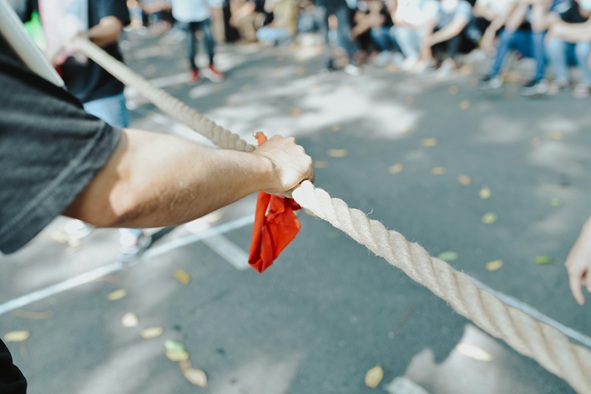
So let’s take it a step further – imagine a marketing team attending an outdoor team‑building day. The facilitator suggests a tug‑of‑war. The ground is uneven, but no one checks it. During the first pull, one participant loses their footing, falls backwards, and fractures their wrist.
In this situation, who may be liable?
- The employer, for failing to ensure the activity was risk‑assessed
- The provider, for not inspecting the ground or giving safety instructions
- Potentially both, depending on the contract between them
This is the kind of scenario where a claim is not only possible but likely to succeed. However, as you can see, it can become complex, so it’s advisable to speak to a solicitor who can assess what happened and whether you have a potential claim
What If the Accident Happens During a “Voluntary” Activity?
Employers sometimes argue that because an activity was “optional”, they aren’t responsible. But optional doesn’t always genuinely mean optional in practice.
If the culture of the workplace makes attendance feel expected – say, the whole team is going, senior managers are present, or the event is framed as essential for team cohesion – then it may still be treated as a work activity.
But, even if the activity is genuinely optional, the provider still owes you a duty of care. So a claim may still be possible, just through a different route.
What If You Signed a Waiver?
Waivers are common for physical activities, but it’s important to know that they don’t give companies a free pass. In the UK, a waiver cannot exclude liability for negligence that leads to personal injury. While, it may limit claims for minor issues or property damage, it cannot override the basic legal requirement to keep participants safe.
If you signed something, it’s still worth exploring a claim. Waivers often look intimidating but carry far less legal weight than people assume and your solicitor is aware of the legalities around waivers.
Common Types of Team‑Building Accidents
While every case is unique, certain patterns appear again and again:
- Slips, trips, and falls during outdoor challenges
- Manual handling injuries during competitive tasks
- Falls from height during climbing or obstacle courses
- Impact injuries from poorly supervised sports‑style games
- Equipment failures during adventure activities
- Burns or cuts during cooking‑based team challenges
How to Know If You Have a Valid Claim After a Team Building Accident
A strong team‑building accident claim usually includes the following three elements:
You were owed a duty of care This is almost always true if the event was work‑related.
That duty was breached Something wasn’t planned, supervised, or executed safely.
You suffered injury as a direct result of that breach Physical or psychological injuries both count.
If you can establish these three key factors, you’re likely to have a claim for compensation.
What Evidence Helps Strengthen a Claim For a Team-Building Injury?
You don’t need to have everything, but the following can make a big difference:
- Photos or videos of the activity or hazard
- Witness statements from colleagues
- Accident book entries
- Medical records
- Emails or messages showing you were expected to attend
- Any instructions (or lack of instructions) given on the day
We’ve seen that even small details may matter. For example, if the facilitator rushed through safety instructions because the schedule was running behind, that could be relevant. Your solicitor will also help you gather the appropriate evidence.
What If You Feel Guilty About Claiming?
Many employees worry about “causing trouble” or “making things awkward”. But employers are legally required to have employers’ liability insurance. Claims are made against the insurer, not the individual manager who organised the day.
However, if you’re injured because someone didn’t take reasonable care, you shouldn’t be left trying to deal with it all – whether it’s managing pain or the financial cost.
How Compensation Is Calculated for a Team-Building Injury
Compensation for team‑building injuries typically covers:
- Pain and suffering
- Loss of earnings
- Medical treatment
- Travel expenses
- Care and support
- Long‑term impact on work or daily life
The amount depends on the severity of the injury and how it affects your life. As each case is different, your solicitor should be able to provide an estimate regarding your claim.
Find Out Now If You Have a Claim
Being injured during a team‑building event can feel not only painful but also embarrassing. You set out to bond with colleagues and ended up dealing medical appointments, and perhaps even uncertainty about the future.
The key is understanding who owed you a duty of care, how that duty was breached, and how the injury has affected you.
We will guide you through the next steps to claim for compensation:
📞 Call us: 0333 358 3034
📧 Email us: info@jefferiesclaims.co.uk
📝 Online: Complete our online form for a free, no-obligation consultation with one of our friendly team.