
1
Contact or call for free on 0333 358 3034

2
Talk through the details of your claim. Just so you know, we're FCA regulated.

3
Find out if you could claim & speak to a real person.

4
Secure the compensation you deserve

Perineal Tear Compensation
Written by Tanya Waterworth, Digital Content Writer
About Our Legal Expert: This content is produced with oversight by Michael Jefferies, Managing Director who has over 30 years’ legal experience.
When Can You Claim For Perineal Tear Compensation?
A serious perineal tear can have long lasting consequences, so if this injury is missed, misdiagnosed or poorly repaired, you may want to find out more about perineal tear compensation. A clinical negligence claim for a severe perineal tear is not that it happened, but rather how it was treated. Typical symptoms may include chronic pain, incontinence, infections and sexual dysfunction.
A recent NHS report on misdiagnosis for perineal tears highlighted that 58% of women had a misdiagnosed perineal tear that was more severe than initially assessed. First time mothers accounted for 84% of claims.
Director of NHS Resolution Safety and Learning, Megan Bidder said, “This report identifies clear areas where care can improve, from safer assisted births to better training in systematic examination techniques”. The average delay before a correct diagnosis was made was 10 months.
So, if you suspect this happened to you, this blog offers essential advice on when you may have a clinical negligence claim and how to get started.
⚠️ Red Flag Symptoms For a Serious Perineal Tear
- Ongoing severe perineal pain that doesn’t improve or worsens over time
- Faecal incontinence — leaking stool or difficulty controlling wind
- A persistent foul smell from the wound or discharge
- Wound breakdown — stitches coming apart or an open gap
- Pain during bowel movements or a sensation of tearing
- Painful sex or inability to attempt intercourse due to discomfort
- A dragging or heavy sensation in the pelvic floor
- Leakage of urine or difficulty controlling the bladder
- A feeling that something is “not right” with healing or continence
What counts as a “serious” perineal tear?
The two most common severe tears include a third‑degree tear extending into the anal sphincter and a fourth‑degree tear extending into the rectal mucosa.
These injuries require prompt recognition and surgical repair by an experienced clinician. The Royal College of Obstetricians and Gynaecologists (RCOG) has comprehensive information on different types of perineal tears in childbirth.
When does a serious perineal tear become clinical negligence?
A tear becomes negligent not because it occurred, but because of how it was handled. Childbirth injuries may often occur even with excellent care. However, it becomes negligence when the standard of care falls below what a competent professional should provide.
Below are some common negligent scenarios:
- Failure to assess properly: When a midwife or doctor does not carry out a full post‑birth examination.
- Misdiagnosis of severity: When a third or fourth‑degree tear is incorrectly recorded as a second‑degree tear, leading to inadequate repair.
- Delay in treatment: When the correct repair is not performed promptly, increasing the risk of infection, breakdown, or long‑term dysfunction.
- Lack of surgical expertise: When a complex tear is repaired by someone without the required skill and the result is poor healing.
- Failure to provide follow‑up care: When women are discharged without proper review, physiotherapy referral, or instructions on symptoms that require urgent attention.
What may actually go wrong in real cases
These following examples come from patterns seen in UK birth‑injury claims:
A “quick stitch‑up” after a long labour
After a difficult birth, staff may be overstretched. Some women report being stitched without a proper examination, often because the tear “looked small”. Later, they discover the anal sphincter was torn.
This is negligent because a rectal exam is mandatory after every vaginal birth.
The “you’re just healing slowly” dismissal
Women often return with severe pain, leakage, or a foul smell. They may be told that this is “normal postpartum healing”. Weeks later, a specialist finds the repair has broken down or the tear was never fully repaired.
This is negligent because red‑flag symptoms require urgent reassessment.
Inadequate repair after a “mislabelled tear”
A midwife may record a second‑degree tear, but the woman later learns she actually suffered a third‑degree tear. This misclassification leads to inadequate repair, which is a common basis for successful claims.
Real‑life examples (anonymised)
Example 1: Misdiagnosed third‑degree tear
A first‑time mother delivered a large baby with forceps. She was told she had a “small tear” and was stitched on the ward. Months later, she developed faecal incontinence. A colorectal surgeon confirmed she had an unrepaired third‑degree tear. Her claim succeeded because no rectal exam was documented, and the tear was clearly visible on later imaging.
Example 2: Delay in theatre repair
A woman with a fourth‑degree tear waited five hours for theatre due to staff shortages. The repair later broke down, requiring multiple surgeries. Her claim succeeded because national guidelines state that complex tears should be repaired promptly to reduce complications.
Example 3: Inadequate follow‑up
A woman repeatedly reported leakage and pain but was told it was “normal”. She was never referred to pelvic‑floor physiotherapy. Her claim succeeded because postnatal follow‑up was below standard, and early intervention would have prevented long‑term dysfunction.
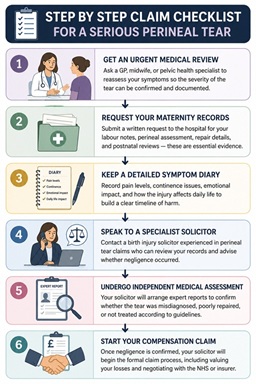
📦 Step‑by‑Step Claim Checklist for a Serious Perineal Tear
1. Get an urgent medical review
Ask a GP, midwife or gynaecologist to reassess your symptoms so the severity of the tear can be confirmed and properly documented.
2. Request your maternity records
Submit a written request to the hospital for your labour notes, perineal assessment, repair details, and postnatal reviews. These records are essential evidence and will form the basis of your claim.
3. Keep a detailed symptom diary
Keep a symptom diary to make notes on your pain levels, continence issues, emotional impact, and how the injury affects your daily life. This record helps to build a clear timeline of harm.
4. Speak to a specialist solicitor
We partner with clinical negligence solicitors who are experienced in birth injury claims. They offer an initial, free consultation when they will advise whether negligence occurred.
5. Undergo independent medical assessment
Your solicitor will arrange an independent expert medical assessment to confirm whether the tear was misdiagnosed, poorly repaired, or not treated according to guidelines.
6. Start your compensation claim
Once negligence is confirmed, your solicitor will begin the formal claim process, including valuing your losses and negotiating with the NHS or insurer. Your solicitor will be able to advise on potential compensation for your specific case.
Useful Tip: Often successful perineal tear claims are due to documentation gaps e.g. if medical notes don’t show a rectal exam or the correct tear grade. Essentially, poor documentation may often reflect a poor standard of care.
How long do you have to claim?
In England and Wales, you generally have three years from the date of injury or from the date you realised something went wrong. Many women only understand the severity of their perineal tear much later, so the “date of knowledge” rule often applies.
Need Help Today?
If you are suffering from ‘red flag’ symptoms, it may be a result of your injury being missed, misdiagnosed, or poorly repaired. If so, you may have grounds for a clinical negligence claim compensation.
We partner with clinical negligence solicitors who offer No Win, No Fee agreements, which means no upfront costs to worry about.
Our caring team can guide you through the process. Either call us at 0333 358 2345 or contact us online for your free consultation.
This blog is for informational purposes only and does not constitute legal or medical advice. Always consult with a medical professional and a qualified solicitor to understand your specific circumstances.